· ReadyStack
Worked example
Real numbers from this tool, line by line.
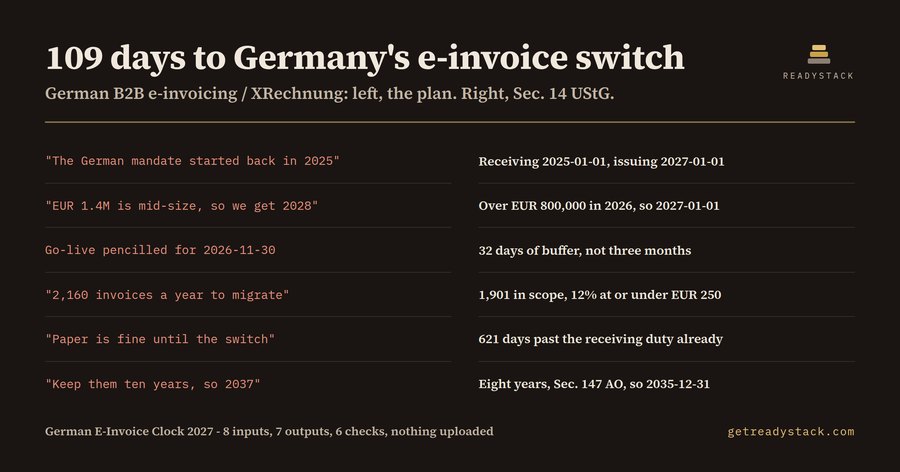
109 days. That is what a German GmbH with EUR 1,400,000 of 2026 turnover has left, counted from 14 September 2026, before a PDF invoice stops being a valid invoice for its German B2B customers. If you are the finance-ops or AP lead at a group outside Germany and that GmbH is one line on your consolidation, nobody has sent you a letter about it.
Germany does not have one e-invoicing date. It has three switches, and the free timelines skip all of them.
The first is receiving. Since 2025-01-01 every domestic German business must already be able to take in a structured e-invoice in an EN 16931 format - XRechnung or ZUGFeRD. No turnover test, no phase-in. On 14 September 2026 that duty has been live for 621 days.
The second is the EUR 800,000 test. Under Sec. 14 UStG as amended by the Growth Opportunities Act, a German entity whose total turnover in the previous calendar year - 2026 - is over EUR 800,000 must issue structured e-invoices for domestic B2B sales from 2027-01-01. Everyone else has until 2028-01-01, when the transitional arrangements expire.
The third is who is caught at all. A small business under Sec. 19 UStG is exempt from issuing, but still has to receive. A supplier with no German establishment is not bound by Sec. 14 UStG in either direction - although a German buyer's contract can still demand XRechnung.
Ask a chatbot when Germany's mandate starts and you get one date for a country. The date you need is for an entity. That is the gap this extension fills.
Type your figures into the popup and it returns seven of them at once. On the values it ships with - EUR 1,400,000 of 2026 turnover, go-live pencilled for 2026-11-30, 180 domestic B2B invoices a month, 12 per cent of them at or under EUR 250, six minutes and EUR 48 an hour to correct a rejected one - the answer is 2027-01-01, 109 days left, 32 days of buffer, 621 days already past the receiving duty, 1,901 invoices in scope, EUR 9,125 a year of rework, and an archive that runs to 2035-12-31.
Two of those numbers are the ones people get wrong by hand. The volume is one: 180 invoices a month is 2,160 a year, but invoices at or under EUR 250 stay exempt, so only 1,901 are in scope. The buffer is the other: a go-live in late November sounds comfortable until the screen says 32 days.
Change one input and the whole schedule moves. Drop the turnover to EUR 640,000, push go-live to 2027-06-30 and cut the volume to 45 invoices a month with 20 per cent under EUR 250, and the same screen returns 2028-01-01, 474 days left, 185 days of buffer, 432 invoices in scope and EUR 2,074 a year. Same rules, different entity, different plan.
The last number is the quiet one. Retention for accounting vouchers dropped from ten years to eight on 2025-01-01, under Sec. 147 AO as amended by the Fourth Bureaucracy Relief Act, counted from the end of the year the document arose. An invoice issued in 2027 is therefore kept to the end of 2035, not 2037 - which matters when you are sizing the archive you are about to buy.
All of that is free, in the popup and on the web page, with no key and no limit: no watermark, no run counter, no blurred answer. The $60 licence adds a different axis, not a bigger one - it exports the worked schedule as a .csv row per entity, the file you paste into the migration plan, and sets a browser reminder on your go-live date and your binding date. A German tax adviser bills a statutory time fee of EUR 35 to EUR 107.50 per half hour under Sec. 13 StBVV, so EUR 70 to EUR 215 for one scoping hour on these dates, per entity, every time the plan moves.
Questions people ask
What does this extension actually tell me?
It applies the German Sec. 14 UStG e-invoicing rules to one entity and returns seven things: your first mandatory issuing date, days left to it, the buffer between your go-live date and that date, days since the 2025-01-01 receiving duty began, invoices in scope per year, the cost of a year of rejected-invoice rework, and the archive year.
Who is it for?
Finance-ops, AP and AR leads at non-German groups that sell into Germany through a German GmbH, UG, AG or registered branch, and who read their rules in English. It is also used by shared-service centres that run several German entities and need each one's date separately rather than one blanket answer.
Why will a free chatbot or a timeline blog not do?
They answer for Germany, not for your entity. They quote 2025, 2027 or 2028 as if one date applied to everyone, and they skip the three switches that decide it: the EUR 800,000 prior-calendar-year turnover test, the small-business exemption from issuing, and the case where you have no German establishment at all.
What is free and what does the paid version add?
Every calculation is free, in the popup and on the web page, with no key and no limit. The paid licence adds two things on a different axis: exporting the worked schedule as a .csv row you keep per entity, and a browser reminder set on your go-live date and your binding date.
What would this cost me otherwise?
A German tax adviser bills a statutory time fee of EUR 35 to EUR 107.50 per half hour under Sec. 13 StBVV, so EUR 70 to EUR 215 for a single scoping hour on these dates, per entity, repeated every time your turnover or your project plan moves. The licence is 60 US dollars once.
Ask about this tool
One question, answered by the person who built it. Your email only if you want the answer sent.